
The dairy industry relies heavily on precise temperature control at every stage of production. From receiving raw milk to processing, pasteurization, cooling, and packaging, maintaining the right temperature is essential for product quality, food safety, and operational efficiency. This is where heat exchangers play a vital role.
Modern dairy plants process thousands of liters of milk and dairy products every day. To ensure consistent quality while minimizing energy consumption, manufacturers depend on efficient heat transfer systems. Heat exchangers help achieve these goals by transferring heat between fluids without allowing them to mix. Did You Know? Modern Plate Heat Exchangers used in dairy pasteurization can recover up to 95% of thermal energy, helping dairy plants reduce energy consumption and operating costs.
In this article, we’ll explore the key applications of heat exchangers in the dairy industry and why they are considered indispensable equipment in dairy processing facilities.
Why Heat Exchangers Are Important in Dairy Processing
Dairy products are highly sensitive to temperature fluctuations. Improper heating or cooling can affect taste, texture, shelf life, and even product safety. Heat exchangers provide controlled and efficient thermal management throughout the production process.
Their benefits include:
- Improved product quality and consistency
- Enhanced food safety and hygiene
- Reduced energy consumption
- Faster processing times
- Lower operating costs
- Compliance with industry regulations
As dairy operations continue to scale, efficient heat transfer systems have become a necessity rather than a luxury.
Applications of Heat Exchangers in the Dairy Industry
1. Milk Pasteurization
Pasteurization is one of the most important applications of heat exchangers in the dairy industry. During this process, milk is heated to a specific temperature for a predetermined period to eliminate harmful microorganisms while preserving nutritional value.
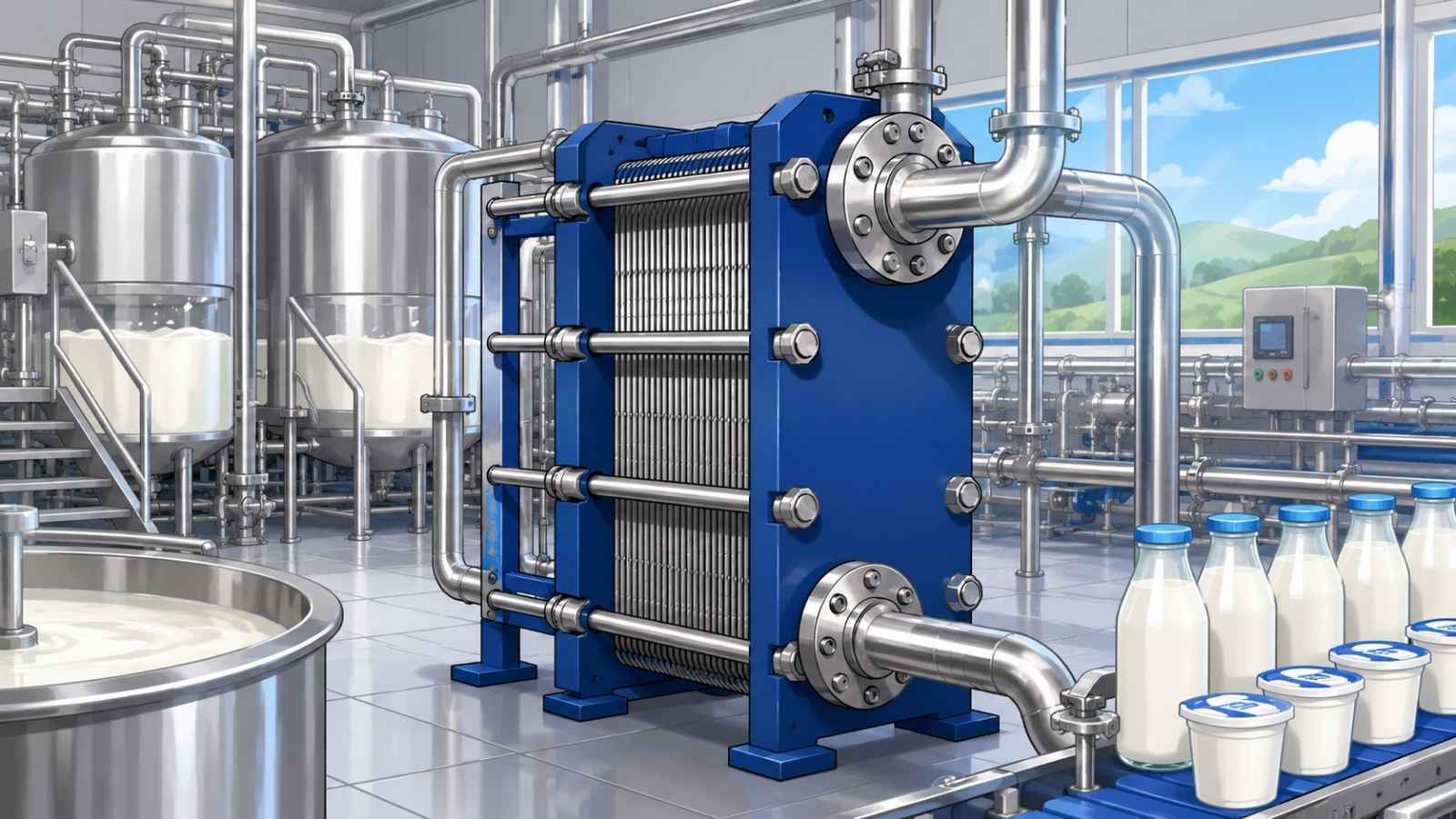
Plate Heat Exchangers (PHEs) are widely used in pasteurization systems because they offer excellent heat transfer efficiency and precise temperature control. The milk is heated using hot water or steam and then rapidly cooled before packaging or further processing.
The regenerative design of many pasteurization systems allows heat from the outgoing hot milk to be recovered and transferred to incoming cold milk. This significantly reduces energy consumption and operating costs.
2. Milk Cooling and Chilling
Raw milk must be cooled quickly after collection to prevent bacterial growth and maintain freshness. Heat exchangers are used to rapidly lower the milk temperature before storage or transportation.
Efficient cooling helps:
- Preserve milk quality
- Extend shelf life
- Reduce microbial activity
- Maintain compliance with food safety standards
Plate heat exchangers are particularly effective in milk chilling applications due to their compact design and high thermal efficiency.
3. Cream Processing
Cream production requires careful temperature control during separation, pasteurization, and storage. Heat exchangers help maintain consistent temperatures throughout the process, ensuring the desired fat content and product quality.
Whether producing fresh cream, whipping cream, or dairy ingredients for further processing, reliable heat transfer equipment contributes to uniform results and improved production efficiency.
4. Yogurt Production
Temperature management plays a critical role in yogurt manufacturing. Milk must be heated before fermentation and then cooled at specific stages to support bacterial cultures and achieve the desired texture.
Heat exchangers help maintain these precise temperature conditions, ensuring consistent fermentation and product quality. Efficient thermal control also reduces production variability and improves batch consistency.
5. Cheese Manufacturing
Cheese production involves several temperature-sensitive stages, including milk treatment, curd formation, whey processing, and product storage.
Heat exchangers are used to:
- Heat milk before coagulation
- Cool products during processing
- Maintain optimal fermentation temperatures
- Recover heat for energy savings
By providing accurate temperature control, heat exchangers help dairy manufacturers achieve consistent flavor, texture, and product quality across production batches.
6. Butter Production
The quality of butter depends significantly on temperature management during cream processing and churning. Heat exchangers help regulate temperatures to achieve the desired consistency and texture.
Proper thermal control improves processing efficiency while ensuring that the final product meets quality expectations.
7. Ice Cream Manufacturing
Ice cream production requires both heating and cooling processes. Ingredients are pasteurized, mixed, homogenized, and then cooled before freezing.
Heat exchangers are used throughout the process to:
- Pasteurize the mix
- Cool ingredients efficiently
- Support freezing operations
- Maintain product consistency
Their ability to deliver rapid and precise temperature control makes them an essential component of modern ice cream production facilities.
8. Whey Processing
Whey, once considered a byproduct, has become a valuable ingredient in the food and nutrition industry. Processing whey into concentrates and powders requires multiple heating and cooling stages.
Heat exchangers support these operations by providing efficient thermal management while helping manufacturers reduce energy consumption and improve production efficiency.
9. CIP (Clean-in-Place) Systems
Hygiene is critical in dairy processing. Heat exchangers are commonly integrated into Clean-in-Place (CIP) systems, where cleaning solutions are heated and circulated through equipment without dismantling production lines.
This process helps maintain sanitary conditions, reduce downtime, and ensure compliance with food safety regulations.
10. Milk Homogenization
Homogenization is a crucial step in dairy processing that prevents cream from separating from milk. During this process, milk is subjected to high pressure to break down fat globules into smaller, evenly distributed particles.
Before homogenization, milk is typically heated to the optimal processing temperature using heat exchangers. Maintaining the correct temperature improves homogenization efficiency and helps achieve a smooth, uniform product with better stability and texture.
Heat exchangers support homogenization by:
- Preheating milk to the required temperature
- Ensuring consistent processing conditions
- Improving product texture and appearance
- Enhancing shelf life and product stability
- Reducing energy consumption through efficient heat transfer
From standard milk production to flavored milk and other dairy beverages, heat exchangers play an important role in preparing products for successful homogenization and consistent quality.
Energy Recovery and Sustainability
One of the most significant advantages of modern heat exchangers is their ability to recover and reuse heat. In dairy plants, large amounts of thermal energy can be captured from outgoing process streams and reused elsewhere in the facility.
Energy recovery systems help:
- Reduce fuel consumption
- Lower operating costs
- Improve overall plant efficiency
- Support sustainability initiatives
- Reduce carbon emissions
As energy costs continue to rise, heat recovery has become a major focus for dairy manufacturers seeking long-term operational savings.
Choosing the Right Heat Exchanger for Dairy Applications
Selecting the appropriate heat exchanger depends on several factors, including product characteristics, processing requirements, hygiene standards, and plant capacity.
Common options include:
- Gasketed Plate Heat Exchangers
- Brazed Plate Heat Exchangers
- Semi-Welded Heat Exchangers
- Fully Welded Heat Exchangers
- Shell and Tube Heat Exchangers
Each design offers specific advantages depending on the application and operating conditions.
Conclusion
Heat exchangers are at the heart of modern dairy processing operations. From pasteurization and cooling to yogurt, cheese, butter, and ice cream production, they ensure efficient temperature control, product safety, and energy savings.
As dairy manufacturers continue to focus on productivity, quality, and sustainability, investing in reliable heat exchanger solutions becomes increasingly important. By selecting the right heat exchanger technology, dairy plants can improve operational efficiency, reduce costs, and maintain the highest standards of product quality.
At SS PHE India, we provide advanced heat exchanger solutions designed to meet the demanding requirements of the dairy industry. Our range of Plate Heat Exchangers and industrial heat transfer systems helps dairy manufacturers achieve efficient, hygienic, and reliable processing performance.